What is Ultrasonic Thickness Measurement?
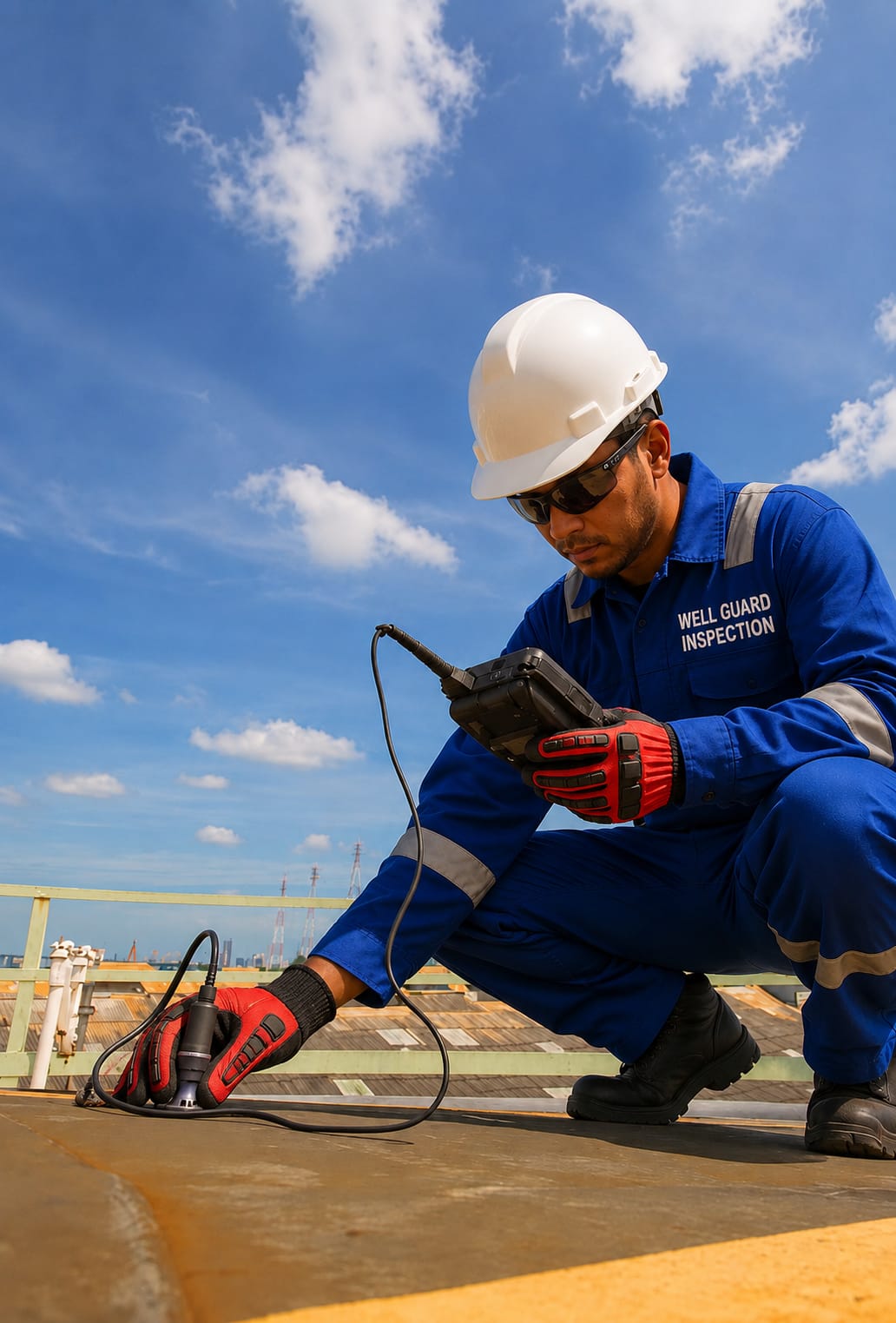
Ultrasonic Thickness Measurement (UTM) is a non-destructive testing technique that uses high-frequency sound waves to measure the thickness of a material from one side only. The technique works by sending an ultrasonic pulse through the material and measuring the time it takes for the echo to return from the back wall. This time-of-flight measurement is converted into a thickness reading.
UTM is essential in the oil and gas industry for monitoring wall thinning due to corrosion, erosion, and other degradation mechanisms. At Well Guard Inspection Services, we use calibrated digital thickness gauges to provide accurate and repeatable measurements on critical assets.
Our UTM Inspection Process
Surface Preparation
Cleaning and preparing the measurement area to remove coating, rust, scale, or other surface irregularities that could affect the ultrasonic signal transmission.
Equipment Calibration
Calibrating the ultrasonic thickness gauge using certified reference blocks to ensure measurement accuracy and traceability.
Couplant Application
Applying an appropriate couplant (gel or liquid) between the transducer and test surface to ensure efficient sound wave transmission into the material.
Thickness Measurement
Taking systematic readings across predetermined grid patterns or specific locations as required by the inspection scope, recording each measurement for analysis.
Data Analysis & Reporting
Analyzing the thickness data to identify areas of concern, comparing against minimum wall thickness requirements, and preparing a comprehensive inspection report with findings and recommendations.
Applications in Oil & Gas
Pipeline Integrity
Monitoring pipeline wall thickness to detect internal and external corrosion, ensuring safe continued operation and compliance with integrity standards.
Pressure Vessels & Tanks
Assessing wall thickness of pressure vessels, storage tanks, and separators to verify structural integrity and fitness for service.
Piping Systems
Measuring process piping, flowlines, and manifolds at critical locations such as bends, tees, and areas prone to erosion-corrosion.
Structural Steel
Evaluating thickness of structural beams, platforms, and supporting members exposed to environmental degradation.
Heat Exchangers
Measuring tube and shell thickness in heat exchanger equipment to assess material condition and remaining service life.