What is BHA Inspection?
The Bottom Hole Assembly (BHA) consists of the heavy-weight components at the bottom of the drill string, including drill collars, stabilizers, reamers, jars, subs, and other specialized tools. These components operate under extreme conditions of compression, torsion, vibration, and abrasive contact with the formation, making them highly susceptible to fatigue, cracking, and mechanical damage.
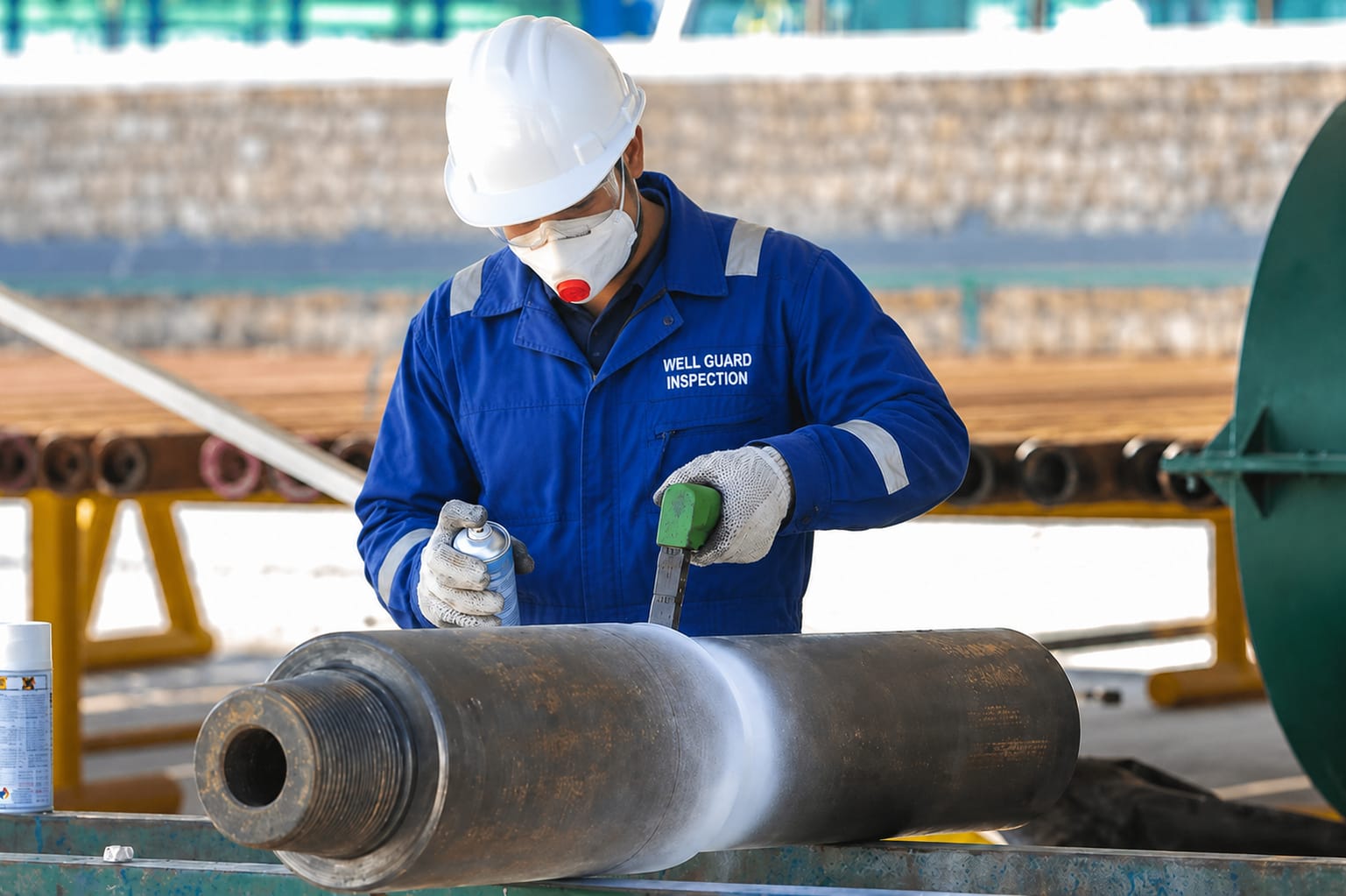
At Well Guard Inspection Services, we provide thorough BHA inspection to ensure that every component is fit for service before it goes downhole. Our inspectors apply a combination of visual, dimensional, and NDT methods to assess the condition of each component and determine its suitability for continued operation.
Components We Inspect
Drill Collars
Full-length visual and dimensional inspection of drill collars, including MPI of connection areas, slip area inspection, and bore condition assessment.
Stabilizers
Inspection of stabilizer blades for wear, damage, and gauge condition. MPI of welded blade attachments and connection threads.
Heavyweight Drill Pipe (HWDP)
Comprehensive inspection of HWDP including center upset, tool joint connections, and tube body assessment for wear and damage.
Crossover Subs
Inspection of crossover subs for thread condition, shoulder condition, dimensional conformance, and surface defects.
Drilling Jars & Shock Tools
External inspection and functional verification of drilling jars and shock absorber tools to confirm operational readiness.
Reamers & Hole Openers
Inspection of reamer bodies, cutting structures, and connections for wear, damage, and serviceability.
Inspection Methods Applied
Visual & Dimensional
Full-length visual examination for external damage, corrosion, and wear. Critical dimensions measured and compared against DS-1 or manufacturer specifications.
Magnetic Particle Inspection
MPI of all connection areas (box and pin), slip areas, and any other high-stress zones to detect fatigue cracks and surface discontinuities.
Thread Gauging
Inspection of all connection threads using calibrated ring and plug gauges to verify thread profile, pitch diameter, lead, taper, and standoff values.
Bore Inspection
Internal bore inspection of drill collars and subs using visual methods or bore gauges to detect internal damage, washouts, or restrictions.
Classification & Reporting
Each component is classified based on its condition, and a detailed inspection report is prepared with measurements, findings, and recommendations.